History of Islam: From Prophet Muhammad ﷺ to the Modern Muslim World
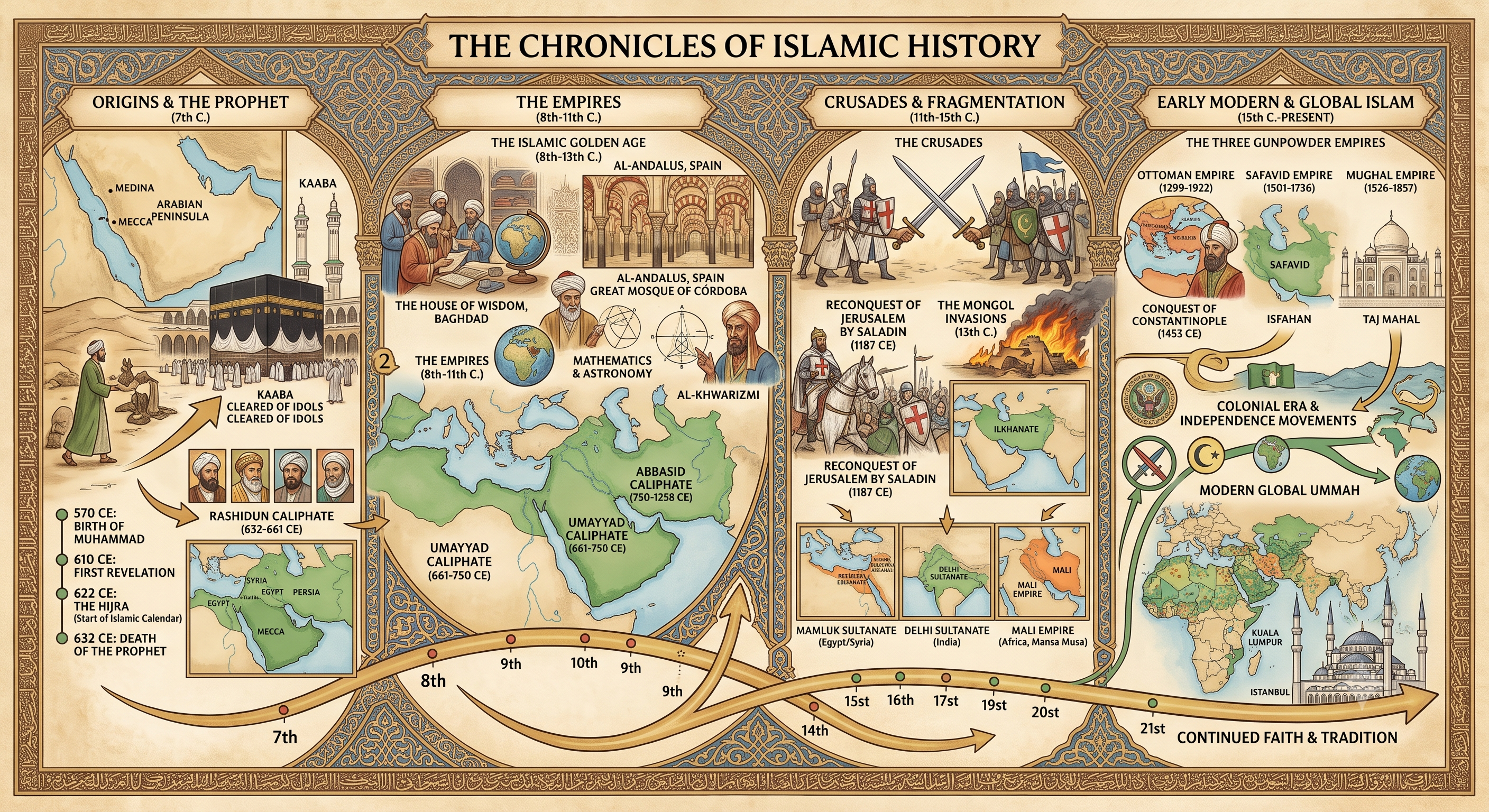
Islam has a history spanning more than fourteen centuries. It began with the message of Prophet Muhammad ﷺ in seventh-century Arabia and developed into a global religious, intellectual, cultural and political civilization.
Today, Islam is practiced by Muslims across almost every region of the world. Although Islam began in Arabia, the majority of Muslims today live outside the Arab world. Muslim communities developed across Africa, Asia, Europe and eventually the Americas and other parts of the world.
The history of Islam is much more than the history of Muslim empires. It is also the history of the Qur'an, Prophet Muhammad ﷺ, the Companions, the Hijrah, Islamic scholarship, Hadith, Islamic law, science, medicine, trade, literature, architecture and the development of Muslim societies across different cultures.
1. What Does Islam Mean?
The Arabic word Islam is commonly understood as submission or surrender to Allah. A Muslim is a person who submits to Allah and follows His guidance.
From the Islamic theological perspective, Islam is not considered a completely new religion that suddenly appeared in the seventh century. Muslims believe that the fundamental message of worshipping one God was taught by earlier prophets, including Adam, Nuh (Noah), Ibrahim (Abraham), Musa (Moses) and Isa (Jesus), peace be upon them.
Prophet Muhammad ﷺ is regarded by Muslims as the final Messenger of Allah. The Qur'an describes Muhammad ﷺ as the "Seal of the Prophets" (Qur'an 33:40). Historically, Islam emerged as a distinct religious community in Arabia during the seventh century CE.
2. Arabia Before Islam
To understand the rise of Islam, it is important to understand the society in which Prophet Muhammad ﷺ was born. The Arabian Peninsula contained different tribes, communities and religious traditions. Makkah was an important religious and commercial center. The Kaaba was already a sacred sanctuary, although it had become associated with numerous idols and polytheistic practices.
Admirable Arab Qualities
- Hospitality & generosity
- Courage & tribal loyalty
- Eloquence in poetry
- Strong oral traditions
Social Problems Faced
- Idolatry & polytheism
- Blood feuds & tribal wars
- Mistreatment of orphans & women
- Economic injustice & slavery
The Qur'an challenged many of these practices and called people toward worshipping Allah alone and establishing justice.
3. The Birth of Prophet Muhammad ﷺ
Prophet Muhammad ﷺ was born in Makkah around 570 CE, according to the traditional historical account. He belonged to the Quraysh tribe and the Banu Hashim clan. His father, Abdullah, died before his birth, and his mother was Aminah bint Wahb. After the death of his mother, Muhammad ﷺ was cared for by his grandfather Abdul Muttalib and later by his uncle Abu Talib.
As he grew older, he became known for his honesty and trustworthy character, earning the titles:
4. The First Revelation
When Muhammad ﷺ was approximately forty years old, he regularly spent time in worship and reflection in the Cave of Hira near Makkah. According to Islamic tradition, Angel Jibril (Gabriel) عليه السلام came to him with the first revelation from Allah.
اقْرَأْ بِاسْمِ رَبِّكَ الَّذِي خَلَقَ
"Read in the name of your Lord who created."
— Surah Al-Alaq 96:1
This marked the beginning of the Prophetic mission of Prophet Muhammad ﷺ. The message called people toward:
- ✓ Tawhid (Worshipping Allah alone)
- ✓ Accountability & The Day of Judgment
- ✓ Prayer & Charity
- ✓ Truthfulness, Justice & Compassion
- ✓ Protection of the weak
- ✓ Moral responsibility
5. The Early Muslims in Makkah
The first people to believe in Prophet Muhammad ﷺ included his wife Khadijah رضي الله عنها, his young cousin Ali ibn Abi Talib رضي الله عنه, his close companion Abu Bakr رضي الله عنه, and other early believers.
The Muslim community was initially small. As the Prophet ﷺ publicly preached Islam, opposition from powerful leaders of Makkah increased, and some early Muslims experienced persecution and hardship. Despite this opposition, the Muslim community continued to grow.
"Worship Allah alone and live a life of righteousness and justice."
6. The Migration to Abyssinia
As persecution increased, some Muslims migrated to Abyssinia (Habasha), traditionally associated with the region of modern Ethiopia and Eritrea. They sought protection under the Christian ruler known in Islamic sources as the Negus (Najashi).
This migration demonstrates that the early history of Islam included interaction with communities of other faiths. It also illustrates the importance placed on seeking safety when religious persecution became severe.
7. The Year of Sorrow
The Prophet ﷺ experienced significant personal losses during his mission. His beloved wife Khadijah رضي الله عنها died. His uncle Abu Talib also died.
These losses occurred around the same period and contributed to what Islamic historical tradition calls the Year of Sorrow (Aam al-Huzn). Despite these difficulties, the Prophet ﷺ continued his mission.
8. The Night Journey and Ascension
According to Islamic belief, Allah granted Prophet Muhammad ﷺ the miraculous journey known as Al-Isra wal-Mi'raj. The Qur'an mentions the night journey from the Sacred Mosque to the Farthest Mosque in Surah Al-Isra.
Islamic tradition further describes his ascension through the heavens. The event is particularly associated with the importance of Salah (prayer).
9. The Hijrah: Migration to Madinah
One of the most important events in Islamic history occurred in 622 CE. Prophet Muhammad ﷺ and his followers migrated from Makkah to Yathrib, which became known as Madinah. This migration is called the Hijrah.
The Hijrah became so important that it was chosen as the starting point of the Islamic calendar. The Islamic calendar therefore begins from the Hijrah rather than from the birth of the Prophet ﷺ or the beginning of revelation.
The migration transformed the Muslim community: in Makkah, Muslims had largely been a persecuted religious minority, whereas in Madinah, they developed an organized community.
10. The Muslim Community in Madinah
Madinah became the center of the emerging Muslim community. Prophet Muhammad ﷺ served as a religious leader as well as a community leader and statesman.
The community included:
- The Muhajirun — migrants from Makkah
- The Ansar — supporters from Madinah
- Other communities living in and around Madinah
The Constitution of Medina is traditionally associated with the organization of relations among different groups in the city. The community emphasized justice, responsibility, mutual protection, community cooperation, and religious obligations.
11. Major Battles and Conflicts
The early Muslim community faced military conflicts with the Quraysh and other groups:
Badr was an important early victory for the Muslims.
Uhud became an important lesson about discipline, obedience and perseverance.
Madinah faced a large coalition, and the Muslims defended the city using a defensive trench.
12. The Treaty of Hudaybiyyah
In 628 CE, the Prophet ﷺ and his companions attempted to perform pilgrimage to Makkah. Negotiations resulted in the Treaty of Hudaybiyyah.
Although some Muslims initially viewed aspects of the agreement as unfavorable, the treaty created a period of relative peace. This period allowed communication between Muslims and other Arabian communities to increase.
13. The Conquest of Makkah
In 630 CE, Prophet Muhammad ﷺ returned to Makkah with a large Muslim force. Makkah came under Muslim control.
According to Islamic tradition, the Prophet ﷺ granted broad forgiveness to many former opponents. The idols around the Kaaba were removed, and the sanctuary was restored to the worship of Allah. The event became one of the defining moments of the Seerah.
14. The Farewell Pilgrimage
Near the end of his life, Prophet Muhammad ﷺ performed his Farewell Pilgrimage. During the pilgrimage, he delivered an important sermon emphasizing fundamental principles of Islam, which remains deeply significant to Muslims around the world.
Themes of the Farewell Sermon
- Human dignity, justice, and responsibility
- Protection of life and property
- Rights and responsibilities of all people
- Abandonment of pre-Islamic blood feuds
- Holding firmly to Islamic guidance
15. The Death of Prophet Muhammad ﷺ & Rashidun Caliphate
Prophet Muhammad ﷺ died in 632 CE in Madinah. His death was a profound moment for the Muslim community. He left behind the Qur'an, his Sunnah and a community of companions who carried the Islamic message forward. The question of leadership after his death became one of the most important developments in Islamic history.
16. The Rashidun Caliphate
After the Prophet ﷺ, the first four caliphs in Sunni historical tradition are known as the Rashidun — the Rightly Guided Caliphs:
Preserved unity during the Ridda conflicts and initiated the formal collection of Qur'anic writings.
Expanded the state to Syria, Palestine, Egypt, and Persia, establishing justice and administration systems.
Standardized and distributed copies of the single canonical written text of the Qur'an to prevent division.
Faced civil wars and political turmoil, assassinated in 661 CE, marking the end of the Rashidun era.
21. Sunni and Shia Historical Traditions
The question of leadership after Prophet Muhammad ﷺ became central to the development of Sunni and Shia traditions:
- Sunni Islam recognize Abu Bakr, Umar, Uthman and Ali رضي الله عنهم as the four Rashidun caliphs.
- Shia Islam place particular importance on Ali ibn Abi Talib رضي الله عنه and his descendants as the rightful spiritual and political successors to the Prophet ﷺ.
These differences developed into distinct theological, legal and historical traditions. They should be studied respectfully and historically.
22. The Umayyad Caliphate
In 661 CE, Muawiyah ibn Abi Sufyan established the Umayyad Caliphate, with Damascus as its political center, ruling from 661 to 750 CE.
During this period, Muslim territories expanded dramatically. The empire eventually stretched from parts of the Iberian Peninsula in the west to Central and South Asian regions in the east. The Umayyad period was therefore a major stage in the transformation of Islam from a regional Arabian movement into a vast international civilization.
23. Islam Reaches Spain
Muslim forces entered the Iberian Peninsula in 711 CE. Islamic civilization subsequently developed in Al-Andalus, especially in cities such as Córdoba, Seville and Granada.
Al-Andalus became an important center of science, medicine, mathematics, philosophy, architecture, literature and agriculture. The history of Muslim Spain was complex and changed considerably over several centuries.
24. The Abbasid Revolution
In 750 CE, the Abbasids overthrew the Umayyads in most of the Islamic world. The Abbasid Caliphate became one of the most influential periods in Islamic history, with Baghdad serving as its political and intellectual center.
The Abbasid period produced major achievements in scholarship, trade, medicine, mathematics, astronomy, philosophy, literature and architecture.
25. The Islamic Golden Age
The phrase Islamic Golden Age is commonly used to describe periods of remarkable intellectual and scientific activity in the medieval Islamic world. Muslim scholars made important contributions to:
Al-Khwarizmi's work contributed to the development of algebra and mathematical methods.
Muslim physicians developed medical encyclopedias, hospitals and clinical practices.
Ibn al-Haytham made influential contributions to the study of light and vision.
Astronomers studied planetary motion, calendars and celestial observations.
Muslim geographers mapped regions across Africa, Asia and Europe.
Philosophers engaged with Greek theories, and literature flourished in Arabic and Persian.
26. Baghdad and the House of Wisdom
Baghdad became one of the world's great intellectual cities. The Abbasid period saw extensive translation and scholarly activity. Works from Greek, Persian, Indian and other intellectual traditions were translated into Arabic.
Muslim scholars did not simply preserve these works. They studied, criticized, expanded and developed them. Knowledge subsequently moved between the Islamic world and Europe through multiple channels.
27. Development of Islamic Scholarship
Islamic civilization produced major scholarly traditions, including Qur'anic studies, Hadith studies, Tafsir, Fiqh, Usul al-Fiqh, Arabic grammar, history, theology, and philosophy. Major scholars emerged across different centuries and regions.
28. The Four Sunni Schools of Islamic Law
Four major Sunni schools of jurisprudence became especially influential, developing different methodologies for interpreting Islamic legal sources:
29. Hadith and the Science of Hadith
Hadith refers to reports concerning the sayings, actions, approvals and characteristics of Prophet Muhammad ﷺ. Muslim scholars developed extensive methods for evaluating hadith reports.
Among the most famous Sunni collections are Sahih al-Bukhari, Sahih Muslim, Sunan Abu Dawud, Jami' al-Tirmidhi, Sunan al-Nasa'i, and Sunan Ibn Majah. Hadith scholarship became one of the most sophisticated fields of Islamic intellectual history.
30. Sufism and Islamic Spiritual Traditions
Tasawwuf, commonly known as Sufism, developed as a major spiritual tradition within Islamic civilization. Sufi scholars emphasized:
- Purification of the heart & sincerity
- Remembrance of Allah & Love of Allah
- Spiritual discipline, humility, and good character
Influential figures included Hasan al-Basri, Junayd al-Baghdadi, Abdul Qadir al-Jilani, Rumi, and Al-Ghazali. Sufi networks later played an important role in the spread of Islam across Africa, Central Asia, South Asia and Southeast Asia.
31. Islam in Africa
Islam spread across Africa through multiple processes, including trade, scholarship, migration, political expansion, Sufi networks, and local conversion. North Africa became an important center of Islamic civilization.
Islam also spread southward through trans-Saharan trade routes. West African Muslim states and empires eventually became major centers of scholarship and commerce.
32. The Mali Empire and Mansa Musa
The Mali Empire became one of the most famous Muslim empires in West Africa. Its ruler Mansa Musa became internationally famous for his pilgrimage to Makkah.
Mansa Musa's journey demonstrated the enormous economic and cultural connections linking West Africa with the wider Muslim world. Timbuktu later became a major center of Islamic learning.
33. Islam in South Asia
Islam has a long and complex history in South Asia. Muslim communities developed through several channels: trade, migration, Sufi teachers, scholars, political dynasties, and local conversion.
Arab merchants had established connections with the western coast of India long before the later Muslim sultanates. The growth of Islam in India was therefore not a single event, but a centuries-long process.
34. The Delhi Sultanate
From the early 13th century, various Muslim dynasties ruled large parts of northern India. These are collectively described as the Delhi Sultanate. Major dynasties included:
The Delhi Sultanate contributed to the development of Indo-Islamic architecture, administration, literature and culture.
35. Sufis and Islam in India
Sufi traditions had a particularly significant role in the religious and cultural history of South Asia. Important figures included Khwaja Moinuddin Chishti, Nizamuddin Auliya, Baba Farid, and Bahauddin Zakariya.
Sufi centers became places of spiritual teaching and community interaction, and their influence remains visible in South Asian Muslim culture today.
36. The Mughal Empire
The Mughal Empire was established in India by Babur in 1526 after his victory at the First Battle of Panipat. The Mughal period became one of the most important chapters in South Asian history.
Major Mughal rulers included Babur, Humayun, Akbar, Jahangir, Shah Jahan, and Aurangzeb.
The empire produced extraordinary achievements in architecture, painting, literature, administration, agriculture, and trade.
37. The Taj Mahal and Islamic Architecture
One of the most famous monuments associated with the Mughal period is the Taj Mahal. Built under Emperor Shah Jahan, it became one of the world's most recognizable examples of Mughal architecture.
Mughal architecture combined influences from Persian, Central Asian, Indian, and Islamic architectural forms. Other famous monuments include the Red Fort, Jama Masjid, Mughal gardens, and numerous Mughal tombs.
38. The Ottoman Empire
The Ottoman Empire became one of the longest-lasting Muslim empires. It emerged in Anatolia and expanded across Southeast Europe, Anatolia, Middle East, and North Africa.
The Ottomans conquered Constantinople in 1453 under Sultan Mehmed II. The city became the Ottoman capital and developed into one of the major centers of the Muslim world.
The Ottoman Empire survived for centuries and ended after World War I. The Ottoman Sultanate was abolished in 1922, while the Ottoman Caliphate was abolished in 1924.
39. The Safavid Empire
The Safavid Empire became one of the most important powers in Persia. The Safavids played a major role in establishing Twelver Shia Islam as the state religion of Iran.
The Safavid period had a profound influence on the religious and political identity of modern Iran.
40. The Three Great Gunpowder Empires
Early modern Islamic history is often discussed through three major empires:
Centered in Anatolia, later spanning large territories across Europe, Asia and Africa.
Centered in Persia.
Centered in South Asia.
41. The Mongol Invasions
The 13th century brought enormous destruction to many parts of the Muslim world. Mongol armies invaded major cities and territories.
In 1258, Baghdad was captured and devastated. The Abbasid political order in Baghdad collapsed. However, Islamic civilization did not disappear. New Muslim political and intellectual centers developed in different regions. Many Mongol rulers and communities later adopted Islam.
42. Islam and Knowledge After the Mongols
Despite political destruction, Islamic scholarship continued. Centers of learning developed across Egypt, Syria, Persia, Anatolia, Central Asia, India, and North Africa.
Scholars continued working in theology, law, medicine, astronomy, mathematics, history, and literature, ensuring the Muslim world remained intellectually diverse.
43. The Spread of Islam Through Trade
Islam did not spread only through political expansion. Trade was extremely important. Muslim merchants traveled across the Indian Ocean, East Africa, Central Asia, Southeast Asia, and the Sahara.
Muslim trading communities established themselves in ports and commercial centers. Over generations, local communities adopted Islam. This process was particularly important in Southeast Asia.
44. Islam in Southeast Asia
Indonesia eventually became the country with the world's largest Muslim population. Islam spread through a combination of trade, Muslim merchants, scholars, Sufi networks, local rulers, and cultural exchange.
The history of Islam in Southeast Asia demonstrates that Islam became deeply rooted in societies through many different processes.
45. Islam and the European Colonial Period
From the 18th and especially the 19th centuries, European imperial powers expanded their influence across many Muslim-majority regions. Major colonial powers included Britain, France, Netherlands, and Russia.
Large parts of South Asia, North Africa, Southeast Asia, and the Middle East came under European political or economic control at different times. This dramatically changed the political structure of the Muslim world.
46. The End of the Ottoman Caliphate
The Ottoman Empire suffered major territorial losses during the 19th and early 20th centuries. After World War I, the empire was dismantled.
The Ottoman Sultanate was abolished in 1922. In 1924, the Turkish Republic abolished the Ottoman Caliphate. This became a major turning point in modern Islamic political history.
47. The Muslim World in the 20th Century
The 20th century saw the emergence of many independent Muslim-majority countries. Political developments included nationalism, independence movements, constitutional reforms, monarchies, republics, and various political movements.
Muslim societies experienced rapid changes in education, technology, urbanization, economics, politics, and media.
48. Islam in the Modern World
Today, Islam is a global religion. Muslims live across Asia, Africa, Europe, North America, South America, and Australia. Major Muslim populations exist in countries such as Indonesia, Pakistan, India, Bangladesh, Nigeria, Egypt, Turkey, Iran, and Saudi Arabia.
Islam is not limited to one ethnicity. Large Muslim populations live outside the Arab world, particularly in South and Southeast Asia.
49. The Qur'an
At the heart of Islam is the Qur'an. Muslims believe the Qur'an is the revealed word of Allah given to Prophet Muhammad ﷺ through Angel Jibril عليه السلام.
The Qur'an contains guidance concerning faith, worship, morality, family, justice, society, charity, accountability, and the Hereafter. It is divided into 114 Surahs. Muslims recite the Qur'an in Arabic during daily prayers and throughout their lives.
50. The Five Pillars of Islam
The religious practice of Islam is commonly summarized through the Five Pillars:
Testifying that there is no deity worthy of worship except Allah and that Muhammad ﷺ is His Messenger.
Performing the five daily prayers.
Giving obligatory charity to eligible recipients.
Fasting during Ramadan.
Performing pilgrimage to Makk for those who are physically and financially able.
51. Islamic Calendar
The Islamic calendar is a lunar calendar. It contains twelve months:
- 1. Muharram
- 2. Safar
- 3. Rabi al-Awwal
- 4. Rabi al-Thani
- 5. Jumada al-Awwal
- 6. Jumada al-Thani
- 7. Rajab
- 8. Sha'ban
- 9. Ramadan
- 10. Shawwal
- 11. Dhul-Qi'dah
- 12. Dhul-Hijjah
Important Islamic occasions include Ramadan, Laylat al-Qadr, Eid al-Fitr, Hajj, Eid al-Adha, Ashura, and Milad-un-Nabi, observed by many Muslim communities. The Islamic calendar begins from the Hijrah in 622 CE.
52. Sunni, Shia and Other Traditions
The Muslim world contains different theological and legal traditions. The two largest branches are Sunni Islam and Shia Islam.
Main branch accepting the historical leadership successors, structured legally around Hanafi, Maliki, Shafi'i, and Hanbali schools.
Branch emphasizing the lineage of Ali and descendants (Imams) as rightful spiritual/political leaders.
There are also Ibadi communities and numerous theological, legal and spiritual traditions. Within Shia Islam are different traditions, including Twelver, Ismaili, and Zaidi. These differences developed through centuries of religious scholarship, political history and interpretation.
53. Islamic Art and Architecture
Islamic civilization produced extraordinary artistic traditions. Examples include mosques, minarets, domes, calligraphy, geometric patterns, arabesque designs, Persian miniature painting, ceramic arts, textiles, and manuscripts.
Famous architectural traditions developed in Makkah, Madinah, Damascus, Baghdad, Cairo, Jerusalem, Istanbul, Isfahan, Delhi, Agra, and Córdoba. Islamic art demonstrates the diversity of Muslim cultures across centuries.
54. Islamic Contributions to Science
Muslim scholars participated in a broad international exchange of knowledge. Their work contributed to areas including:
- Mathematics: Algebra and mathematical computation.
- Medicine: Medical encyclopedias, hospitals and clinical knowledge.
- Astronomy: Observational astronomy and astronomical tables.
- Optics: Research into light and vision.
- Geography: Maps, travel accounts and geographical descriptions.
- Engineering: Mechanical devices and practical technologies.
The Islamic intellectual tradition was connected to knowledge from Greek, Persian, Indian and other civilizations.
55. Muslims and Education
Education has historically been highly valued in Muslim societies. Institutions such as madrasas, mosques, libraries and scholarly circles became centers of learning.
Among the world's oldest centers of Islamic learning are institutions associated with Al-Azhar in Cairo and Al-Qarawiyyin in Fez. Scholars traveled long distances to study with teachers and transmit knowledge.
56. The Importance of Arabic
Arabic became the primary language of Islamic scripture and scholarship. The Qur'an is in Arabic. Arabic also became an international scholarly language during major periods of Islamic civilization.
However, Islamic civilization was never limited to Arabic. Persian, Turkish, Urdu, Malay, Bengali, Swahili and many other languages became important languages of Muslim literature and scholarship.
57. Islamic Civilization Was Multicultural
One of the most important facts about Islamic history is its diversity. Muslim civilization included people from Arabia, Persia, Africa, Central Asia, South Asia, Southeast Asia, and Europe.
Persians, Turks, Arabs, Berbers, Africans, Indians and many other peoples contributed to Islamic civilization. Islam therefore developed into a global civilization rather than remaining limited to one ethnicity.
58. Important Muslim Scholars
Across Islamic history, many scholars became influential. Some widely known figures include:
Their contributions ranged from Islamic law and Hadith to mathematics, medicine, philosophy, history and spirituality.
59. Ibn Khaldun and the Study of History
One of the most remarkable Muslim historians was Ibn Khaldun. He lived in the 14th century and wrote the famous Muqaddimah.
He developed ideas concerning society, economics, political power, civilization, group solidarity and the rise and fall of states. His work is often discussed as an important precursor to modern historical and social analysis.
60. The Meaning of Jihad
The word jihad comes from an Arabic root associated with striving or exerting effort. It has multiple meanings depending on context. It can refer to:
- Spiritual struggle
- Moral effort
- Striving for righteousness
- Defending a community under legitimate circumstances
The concept has a complex history in Islamic law and political thought. It should not simply be translated as "holy war," because that translation does not capture the full range of meanings associated with the term.
61. Islam and Other Religions
Islam emerged within the broader Abrahamic religious environment. Muslims recognize many earlier prophets, including Adam, Nuh, Ibrahim, Musa, Dawud, Sulayman, and Isa, peace be upon them.
Islamic theology therefore has important connections with Judaism and Christianity while differing on major theological questions. Muslims believe that Muhammad ﷺ is the final prophet.
62. Islam and Religious Diversity
Throughout history, Muslim-ruled societies included people of different religions. The treatment of religious minorities varied significantly according to time, place, ruler and legal system.
There were periods of cooperation and coexistence, as well as periods of discrimination, conflict and persecution. A responsible history of Islam should acknowledge both realities rather than presenting Muslim history as entirely peaceful or entirely violent. History is complex.
63. Why Studying Islamic History Matters
Studying Islamic history helps Muslims understand where their traditions came from. It also helps non-Muslims understand one of the world's major civilizations.
Islamic history teaches us about faith, leadership, scholarship, political power, trade, culture, migration, conflict, cooperation, science, architecture, and literature.
"No civilization remains unchanged."
Muslim societies developed, succeeded, experienced internal conflicts, faced invasions, produced extraordinary scholarship, declined in some regions and flourished in others.
64. A Simple Timeline of Islamic History
| Period | Major Event |
|---|---|
| c. 570 CE | Birth of Prophet Muhammad ﷺ |
| c. 610 CE | Beginning of revelation in Cave Hira |
| 622 CE | Hijrah (Migration) to Madinah |
| 624 CE | Battle of Badr |
| 625 CE | Battle of Uhud |
| 627 CE | Battle of the Trench |
| 628 CE | Treaty of Hudaybiyyah |
| 630 CE | Conquest of Makkah |
| 632 CE | Death of Prophet Muhammad ﷺ |
| 632–661 CE | Rashidun (Rightly Guided) Caliphate |
| 661–750 CE | Umayyad Caliphate (Damascus) |
| 750–1258 CE | Abbasid Caliphate (Baghdad Golden Age) |
| 711 CE onward | Development of Muslim rule in Al-Andalus (Spain) |
| 1206 onward | Delhi Sultanate period in South Asia |
| 1258 CE | Mongol capture and sack of Baghdad |
| 1453 CE | Ottoman conquest of Constantinople (Istanbul) |
| 1501 onward | Safavid Empire in Persia |
| 1526 CE | Mughal Empire established in South Asia |
| 1922 CE | Ottoman Sultanate abolished |
| 1924 CE | Ottoman Caliphate abolished |
| 20th-21st c. | Modern Muslim nation-states and global Muslim communities |
65. The History of Islam Is Still Being Written
Islamic history did not end with the fall of an empire. It continues today. Muslims are building communities, universities, businesses, mosques and cultural institutions across the world.
Modern Muslim societies participate in science, medicine, technology, education, business, literature, politics, and the arts. The Muslim world today is extraordinarily diverse.
Conclusion: More Than 1,400 Years of Islamic History
The history of Islam begins, historically, with the mission of Prophet Muhammad ﷺ in seventh-century Arabia, but its story quickly became much larger than Arabia. It became the history of a global community.
From Makkah and Madinah to Baghdad, Damascus, Cairo, Córdoba, Istanbul, Delhi, Timbuktu and Jakarta, Muslims built communities and civilizations across enormous distances.
The story includes periods of extraordinary achievement and periods of political conflict. It includes scholars and rulers, scientists and poets, merchants and travelers, teachers and ordinary people.
It includes the Qur'an, Sunnah, Islamic law, scholarship, spirituality, architecture, science and culture. Most importantly, for Muslims, Islamic history is inseparable from the life and message of Prophet Muhammad ﷺ. His message transformed Arabian society and eventually influenced civilizations across continents.
More than fourteen centuries later, Muslims around the world continue to recite the Qur'an, perform Salah, fast Ramadan, give Zakat, perform Hajj and follow the Sunnah of the Prophet ﷺ.
The history of Islam is therefore not simply a story of the past. **It is a living history carried forward by Muslim communities around the world.**
May Allah guide us to understand the history of Islam with knowledge, honesty and wisdom, and may He help us benefit from the lessons of those who came before us.
اللهم صل وسلم على نبينا محمد ﷺ
"May peace and blessings be upon our beloved Prophet Muhammad ﷺ."